Nigeria Cannot Afford to Keep Technology Out of the Classrooms or Away From Children
Chidirimunma Ifeanyi-Ezechukwukere · October 1st, 2026
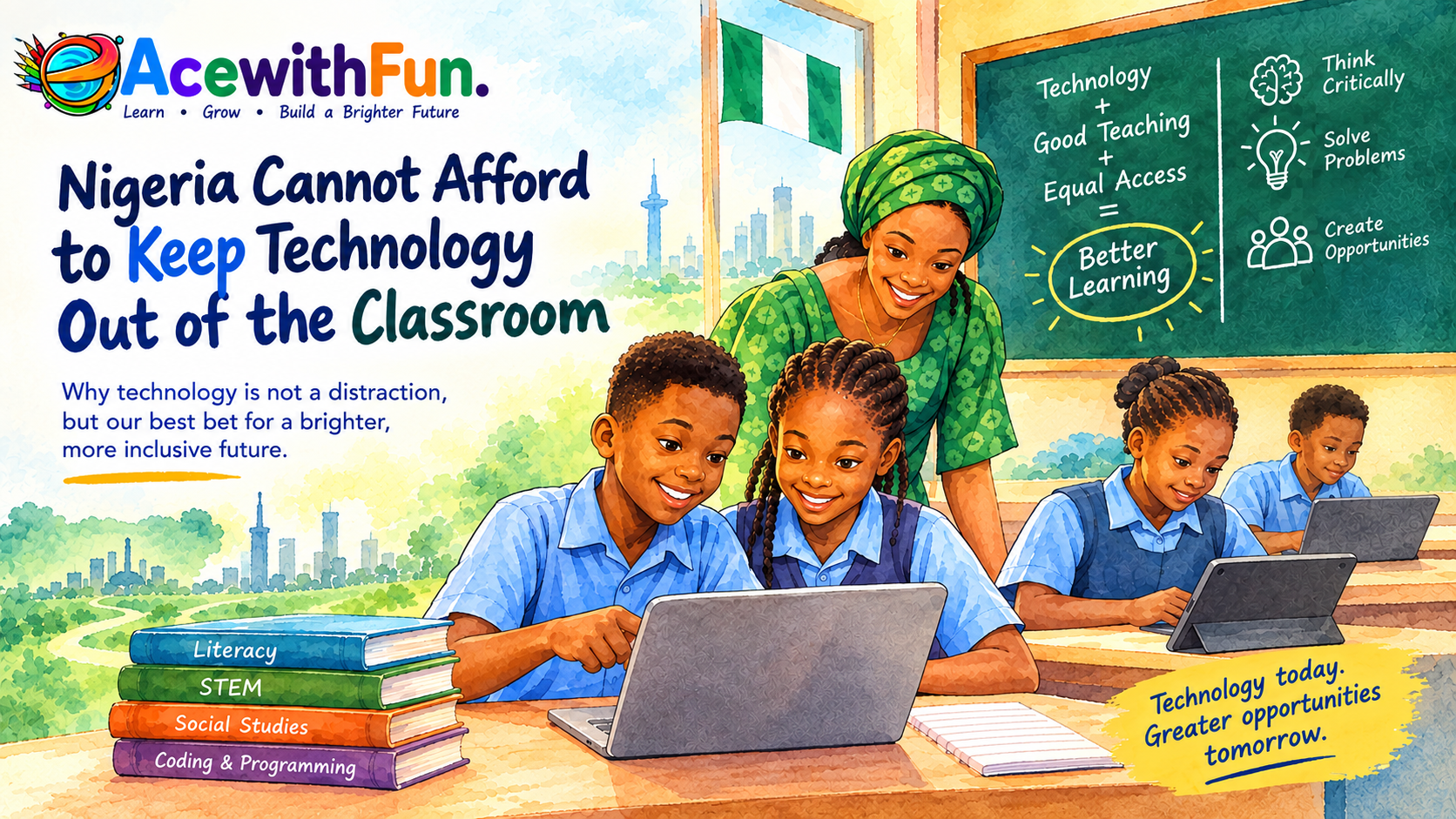
Nigeria Cannot Afford to Keep Technology Out of the Classrooms or Away From Children (Part 1)
Why Nigeria’s Education Reality Requires a Different Approach
There is an increasingly important debate taking place around technology and education.
In parts of Europe, governments and education systems are reconsidering how much technology children should use in school. Sweden has been moving toward more reading, writing and analogue learning in the early years and has pursued policies to make schools increasingly mobile-free. The Netherlands has also introduced nationwide agreements restricting mobile phones and other personal devices in classrooms, except when they are genuinely needed for educational purposes. These policies are being driven by legitimate concerns about distraction, concentration, reading, physical activity and children’s wellbeing.
Those concerns deserve to be taken seriously.
But there is a danger when a solution developed for one education system is treated as a universal prescription for another.
Nigeria is not Sweden. Nigeria is not the Netherlands. And our educational problem is not primarily that Nigerian children have too much technology in classrooms.
Our problem is that millions of children do not have enough access to quality learning at all.
Nigeria faces enormous gaps in foundational literacy and numeracy, teacher availability, school infrastructure, early childhood education, learning resources and equitable access. At the same time, the country has one of the world’s youngest and fastest-growing populations.
This creates a very different policy question.
For a wealthy education system that already has relatively strong infrastructure, high teacher availability, extensive social protection and broad access to learning resources, reducing children’s exposure to certain technologies may be a reasonable policy choice.
For Nigeria, the question should be:
How can we use technology responsibly to expand access, improve teaching quality, strengthen foundational learning and prepare children for the world they will actually inherit?
That is a different question.
And Estonia provides an important example of what that alternative can look like.
Estonia is not arguing that children should be permanently connected to screens. Instead, it is building digital and AI capability into education while investing in teachers, digital literacy and responsible use. Its AI Leap initiative provides AI tools and structured support to teachers and upper-secondary students, building on the country’s earlier Tiger Leap programme, which helped establish its digital education infrastructure.
Nigeria should learn from this principle while developing an approach designed specifically for Nigerian realities.
The argument is not “technology everywhere.”
The argument is technology where it solves real educational problems, with strong pedagogy, responsible safeguards and human teachers at the centre.
Because for Nigeria, technology is not simply another classroom accessory.
Used correctly, it may be one of the few scalable tools available to us for closing an education gap that is already enormous—and growing.
1. Nigeria’s Education Crisis Is Too Large for Conventional Solutions Alone
Before debating whether children should have more or less technology in school, we need to confront the scale of Nigeria’s education challenge.
According to UNICEF, Nigeria has approximately 10.2 million children of primary-school age and 8.1 million children of junior-secondary-school age out of school. That means more than 18 million children in those age groups are outside formal schooling. UNICEF also reports that 74% of Nigerian children aged 7–14 lack basic reading and mathematics skills.
These are not marginal gaps.
They represent a national learning crisis.
The 2024 UNICEF Situation Analysis of Children and Adolescents in Nigeria reports that only 27% of children aged 7–14 demonstrate reading comprehension, while only 25% can solve simple mathematical problems. It also reports that only 38% of three- and four-year-olds benefit from preschool education.
In other words, Nigeria is confronting two problems simultaneously.
First, millions of children are not getting into school.
Second, many of those who are in school are not acquiring the foundational skills that school is supposed to provide.
This distinction matters.
Increasing enrolment without increasing learning does not solve the education crisis. A child can spend years inside a classroom and still leave without the literacy, numeracy, problem-solving and digital skills required to participate productively in the economy.
The World Bank’s definition of learning poverty captures this problem particularly clearly: a child is considered to be in learning poverty when, by age 10, they cannot read and understand a simple age-appropriate text. Globally, around seven in ten children in low- and middle-income countries are estimated to experience learning poverty. For Nigeria, available evidence suggests the situation is even more severe, with estimates indicating that more than 75% of children may be unable to read and understand a simple text by age 10.
This is why the technology debate must be placed in context.
If Nigeria had a situation in which virtually every child had access to an excellent school, a well-trained teacher, adequate instructional materials, a functioning library, a science laboratory, reliable electricity and individualised academic support, then reducing technology might be a reasonable debate to have.
But that is not our reality.
Nigeria needs more teachers, better teachers, better learning materials, more classrooms, more laboratories, more early-years provision, better assessment and dramatically greater access to quality instruction.
Technology cannot solve all of those problems.
But it can help us scale some solutions much faster than traditional infrastructure alone can.
A high-quality digital lesson can potentially reach thousands of children.
A digital assessment can identify learning gaps more quickly.
An adaptive learning system can provide additional practice to a child who needs it without requiring a teacher to manually prepare another 30 worksheets.
A teacher can use digital resources to enrich a lesson rather than create every instructional material from scratch.
And a child who lives hundreds of kilometres from a specialist teacher can potentially access instruction that would otherwise be unavailable.
Technology should therefore not be presented as a replacement for education.
It should be viewed as part of the infrastructure for expanding education.
Nigeria’s challenge is too large for us to reject any scalable tool that can responsibly help us address it.
The question is not whether technology has limitations.
It does.
The question is whether Nigeria can afford not to use every effective tool available to improve learning at scale.
2. We Do Not Have Enough Classrooms, Teachers or Learning Resources
The physical education system is another reason Nigeria’s technology conversation must be different.
According to UNICEF’s 2024 Situation Analysis, Nigeria faces a shortage of approximately 194,876 qualified teachers in basic education. The same analysis reports that the national public-primary-school teacher-to-pupil ratio is around 1:47, compared with a national policy target of 1:35.
In some areas, the situation is considerably worse.
The UNICEF analysis cites teacher-pupil ratios exceeding 1:52 in some northern states and ratios as high as 1:105 in Jigawa and Katsina.
Imagine what that means inside a classroom.
One teacher attempting to teach more than 100 children cannot realistically provide every child with individual attention. Even an exceptionally dedicated teacher faces limits of time, energy and instructional capacity.
The infrastructure problem is equally serious.
UNICEF reports that Nigeria needs hundreds of thousands of additional classrooms and identifies inadequate classrooms, teaching aids, libraries and laboratories as major constraints on education quality. Only 5.7% of public primary schools were reported to have computers, while laboratories were available in only about 46% of junior secondary schools.
This is the environment in which the technology debate is taking place.
We should absolutely build more classrooms.
We should absolutely train and recruit more teachers.
We should absolutely improve school buildings, electricity, sanitation, libraries, laboratories and learning materials.
But these things take time and substantial capital.
A classroom has to be planned, funded, constructed, furnished and maintained.
A teacher has to be recruited, trained, deployed, paid and continuously supported.
And Nigeria needs these interventions at enormous scale.
Technology can provide a parallel pathway.
It can allow one excellent lesson to be delivered repeatedly across many classrooms.
It can give teachers access to high-quality instructional materials.
It can provide demonstrations that would otherwise require expensive laboratory equipment.
It can expose children to simulations, animations, interactive exercises and visual explanations.
It can support teachers with lesson planning and assessment.
It can provide additional practice for children who need reinforcement.
And increasingly, AI can make digital learning more adaptive, allowing educational systems to respond to individual learners rather than treating an entire classroom as though every child has exactly the same needs.
None of this means replacing teachers.
In fact, Nigeria should be thinking about technology as a teacher multiplier, not a teacher replacement.
A good teacher using good technology can potentially reach and support more learners than a good teacher working entirely without it.
That distinction is important.
The answer to a shortage of teachers should not be “let AI teach the children.”
The answer should be:
Train more teachers, support the teachers we already have, and give those teachers better tools.
Technology should strengthen the human education system, not attempt to eliminate it.
For a country facing enormous shortages in teachers and physical learning resources, refusing to use technology because technology itself has risks would create another risk: leaving millions of children without access to the additional learning support technology can provide.
Nigeria needs to build the physical education system.
But while we are building it, we also need tools that can help us educate children today.