The Digital Divide Is Increasing Every Day
Chidirimunma Ifeanyi-Ezechukwukere · October 26th, 2026
Why Nigeria Cannot Afford to Keep Technology Out of the Classroom or Away From Children (Part 3)
6. AI Is Accelerating the Digital Divide
The internet created a digital divide.
Artificial intelligence may create an even more consequential one.
The first digital divide was largely about whether people had access to computers and the internet.
The emerging AI divide is more complicated.
It is about access to computing power, data, high-quality AI models, digital skills, research capacity, investment, infrastructure and the ability to apply AI productively.
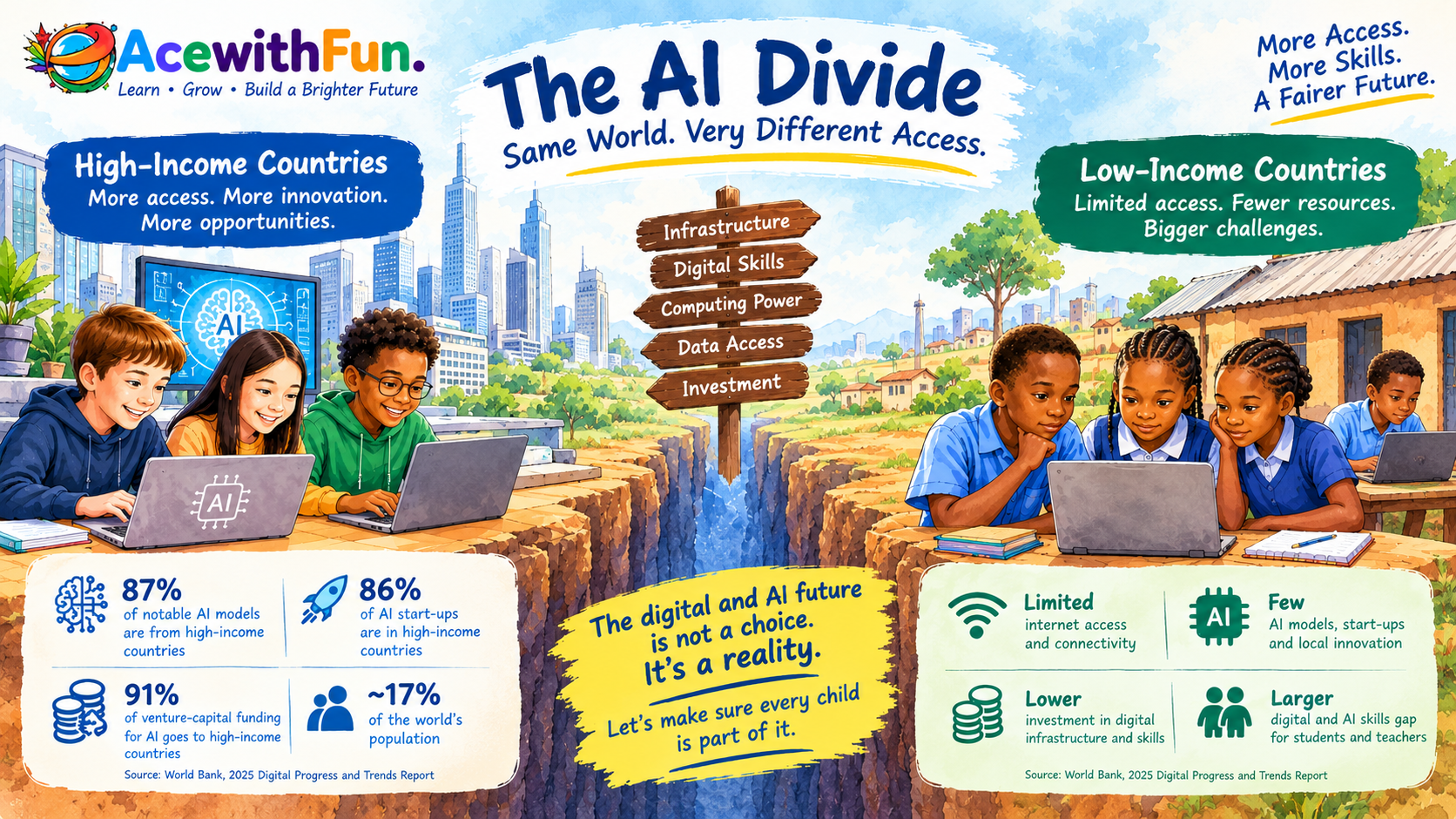
The World Bank’s 2025 Digital Progress and Trends Report describes a growing global AI divide. High-income countries dominate AI innovation, computing infrastructure and startup funding, while adoption remains much more limited in low-income economies.
The concentration is striking.
According to the World Bank, high-income countries account for approximately 87% of notable AI models, 86% of AI start-ups and 91% of venture-capital funding, despite representing only about 17% of the world’s population.
That should concern every country that wants to compete in the future economy.
AI is not simply another technology that will arrive gradually over several decades.
It is advancing rapidly.
Every year, models become more capable.
Every year, businesses discover new applications.
Every year, new AI-enabled products emerge.
And every year, workers and students in technologically advanced environments gain more opportunities to practise with these tools.
This creates a compounding effect.
A student who learns how to use AI responsibly can use it to learn more.
A teacher who knows how to use AI can potentially prepare differentiated materials more efficiently.
A company that adopts AI can become more productive.
A country that develops AI skills can create businesses and services around AI.
The opposite can also happen.
A child without digital access may fall further behind a child who has it.
A teacher without digital skills may struggle to keep pace with digitally enabled colleagues.
A country without AI capacity may become primarily a consumer of technologies created elsewhere.
This is the danger of waiting.
And it is particularly relevant to Nigeria because the country’s young population is potentially one of its greatest assets.
The World Bank also reports an encouraging development: by mid-2025, more than 40% of global ChatGPT traffic came from middle-income countries, demonstrating that people in developing economies are already adopting generative AI at significant scale.
The question is whether this adoption becomes productive and educational—or remains largely informal consumption.
Nigeria should want the former.
Our children should not encounter AI for the first time when they are applying for jobs.
They should encounter it in an educational environment where teachers can help them understand its strengths and weaknesses.
They should learn that AI can generate an answer but cannot automatically guarantee truth.
They should learn about bias.
They should learn about privacy.
They should learn about verification.
They should learn when not to use AI.
They should learn how to ask better questions.
They should learn how to use AI to explore ideas without surrendering their own thinking.
This is what makes Estonia’s approach interesting.
Estonia’s AI Leap is not simply about giving students AI tools. Its official programme places significant emphasis on teacher competence, AI literacy and monitoring how AI affects learning and thinking.
That principle is highly relevant to Nigeria.
We should not simply give children ChatGPT and call it AI education.
We should build AI literacy.
The objective should be to produce children who are capable of thinking with technology rather than children who cannot think without it.
Because if AI is accelerating the digital divide, the answer cannot be to slow Nigerian children down.
The answer must be to help them catch up—and eventually compete.
7. The Danger of Copying Policies Designed for Completely Different Realities
This is where the debate about Sweden, the Netherlands and other wealthy countries requires nuance.
Their concerns are legitimate.
Children can be distracted by phones.
Excessive recreational screen use can interfere with sleep, physical activity and concentration.
Social media can expose children to harmful content.
AI can produce misinformation.
Unregulated technology use can create genuine educational and developmental problems.
Nigeria should not ignore any of these concerns.
But there is a major difference between learning from another country’s experience and copying another country’s policy.
The Netherlands has restricted the use of mobile phones and other personal devices in classrooms, with exceptions for educational purposes and specific needs. Sweden has been pursuing policies aimed at reducing children’s recreational screen exposure and strengthening analogue learning, particularly among younger children.
These policies exist within education systems that have very different starting conditions from Nigeria.
That difference matters.
Imagine two countries.
Country A has a relatively high level of school enrolment, extensive physical infrastructure, comparatively high public resources per learner, strong connectivity, established teacher systems and broad access to learning materials.
Country B has millions of children outside school, significant shortages of qualified teachers, inadequate classrooms, major disparities between regions and socioeconomic groups, and very limited access to educational technology in many public schools.
A policy that makes sense for Country A cannot automatically be transplanted into Country B.
The danger is that we may focus on the visible problem—“screens are distracting”—without considering the invisible opportunity cost.
What happens if a Nigerian school bans technology without having sufficient books?
What happens if a child loses access to a digital lesson without receiving an equivalent high-quality physical resource?
What happens if teachers are already overstretched and technology that could have helped them prepare or differentiate lessons is removed?
What happens to children in communities where digital platforms could provide access to resources their physical school simply does not have?
A technology ban does not automatically create a better education system.
It creates less technology.
Those are not the same thing.
The Netherlands itself recognises this distinction. Its policy is not a rejection of educational technology altogether. Educational use remains an exception, and schools retain responsibility for implementing appropriate policies.
Sweden’s policy direction likewise does not mean that technology has no legitimate role in education. Rather, it reflects a policy judgement about when and how digital tools should be used, particularly for younger children.
Nigeria needs to make its own judgement.
The mistake would be to ask:
“What are Sweden and the Netherlands doing?”
The better question is:
“What problem are they solving, what conditions made their solution appropriate, and what parts of that lesson apply to Nigeria?”
Nigeria should learn from their concerns about distraction.
We should learn from their emphasis on reading.
We should protect children from harmful digital environments.
We should regulate inappropriate use of devices.
We should not allow technology to replace play, physical activity, social interaction or human relationships.
But we should also recognise our own problems.
We have millions of children who need better access to quality learning.
We have major teacher shortages.
We have infrastructure deficits.
We have a rapidly growing population.
And we are entering an era in which digital and AI capability will increasingly influence economic opportunity.
Our response must therefore be Nigerian.
Not anti-technology.
Not technology-at-all-costs.
But technology with purpose.
8. Nigeria Needs an Estonian Principle—Adapted to Nigerian Reality
The most useful lesson from Estonia is not that Nigeria should copy Estonia.
It is that countries should design technology policy around their own educational realities.
Estonia’s experience is particularly interesting because the country did not wait for technology to become perfect before incorporating it into education.
Its earlier Tiger Leap programme helped bring computers and internet connectivity into Estonian schools. Decades later, Estonia is building on that foundation through AI Leap.
The current AI Leap programme provides AI tools and structured support to upper-secondary students and teachers, with strong emphasis on teacher competence and responsible use.
The underlying philosophy is simple:
Do not teach children to avoid the future. Teach them how to navigate it.
Nigeria needs that principle—but with Nigerian priorities.
Our version should begin with the problems we actually have.
First, technology should help strengthen foundational literacy and numeracy.
A child who cannot read should not simply be given an AI chatbot.
Technology should help that child learn to read.
A child struggling with mathematics should receive targeted practice and explanations appropriate to their learning level.
Second, technology should strengthen teachers rather than replace them.
Nigeria needs more teachers, not fewer.
Digital platforms should provide teachers with quality content, assessment tools, professional development, classroom resources and data that help them understand how their students are learning.
Third, technology should expand access.
A child should not have to live in Lagos, Abuja or another major urban centre to access high-quality educational content.
Where physical infrastructure is unavailable or inadequate, digital learning should provide another pathway.
Fourth, Nigeria needs age-appropriate AI literacy.
Young children can learn simple concepts about intelligent machines and patterns.
Primary-school children can explore how AI appears in everyday life.
Older children can learn about data, algorithms, bias, ethics and responsible use.
Teenagers can learn to use generative AI for research, creativity, coding and productivity while learning to verify information and maintain independent judgement.
Fifth, technology policy must include safeguards.
Nigeria should not simply import devices and applications.
We need standards for children’s privacy, data protection, cybersecurity, age appropriateness, accessibility, teacher training and responsible AI use.
Sixth, we need a blended model.
There should be books.
There should be handwriting.
There should be mathematics done on paper.
There should be physical play.
There should be conversation.
There should be art, music, science experiments and social interaction.
And there should also be carefully designed digital learning.
The goal should never be maximum screen time.
It should be maximum meaningful learning.
This is the distinction that can move the debate forward.
Technology is not inherently good.
Technology is not inherently bad.
It is a tool.
Its educational value depends on what we use it for, how we use it, who controls it, what safeguards surround it and whether it improves actual learning.
Nigeria therefore does not need to choose between a completely analogue classroom and a completely digital classroom.
We need a human-centred, technology-enabled education system.
One where teachers remain essential.
One where foundational skills remain essential.
One where children learn to think independently.
One where technology expands access rather than creating another layer of inequality.
One where AI is taught responsibly rather than encountered accidentally through social media.
And one where Nigerian children are prepared not for the world we wish they had, but for the world that is actually arriving.
Estonia’s lesson is not “put AI everywhere.”
Its lesson is more profound:
When a technology is going to shape society anyway, education should help children understand it, use it wisely and remain in control of it.
Nigeria cannot afford to sit outside that transformation.
We have too many children.
Too many learning gaps.
Too few teachers.
Too many infrastructure challenges.
And too little time.
Technology will not solve Nigeria’s education crisis by itself.
But given the scale of the challenge, refusing to use it would mean deliberately leaving one of the most powerful tools of the modern world outside the classroom.
Nigeria does not need less ambition for technology in education. We need better technology, better pedagogy, better safeguards and a much clearer understanding of what technology is supposed to accomplish.
That is the path toward an education system that is not merely catching up with the present—but preparing Nigerian children for the future.