Why Nigeria’s Education Reality Needs a Different Approach
Chidirimunma Ifeanyi-Ezechukwukere · October 10th, 2026
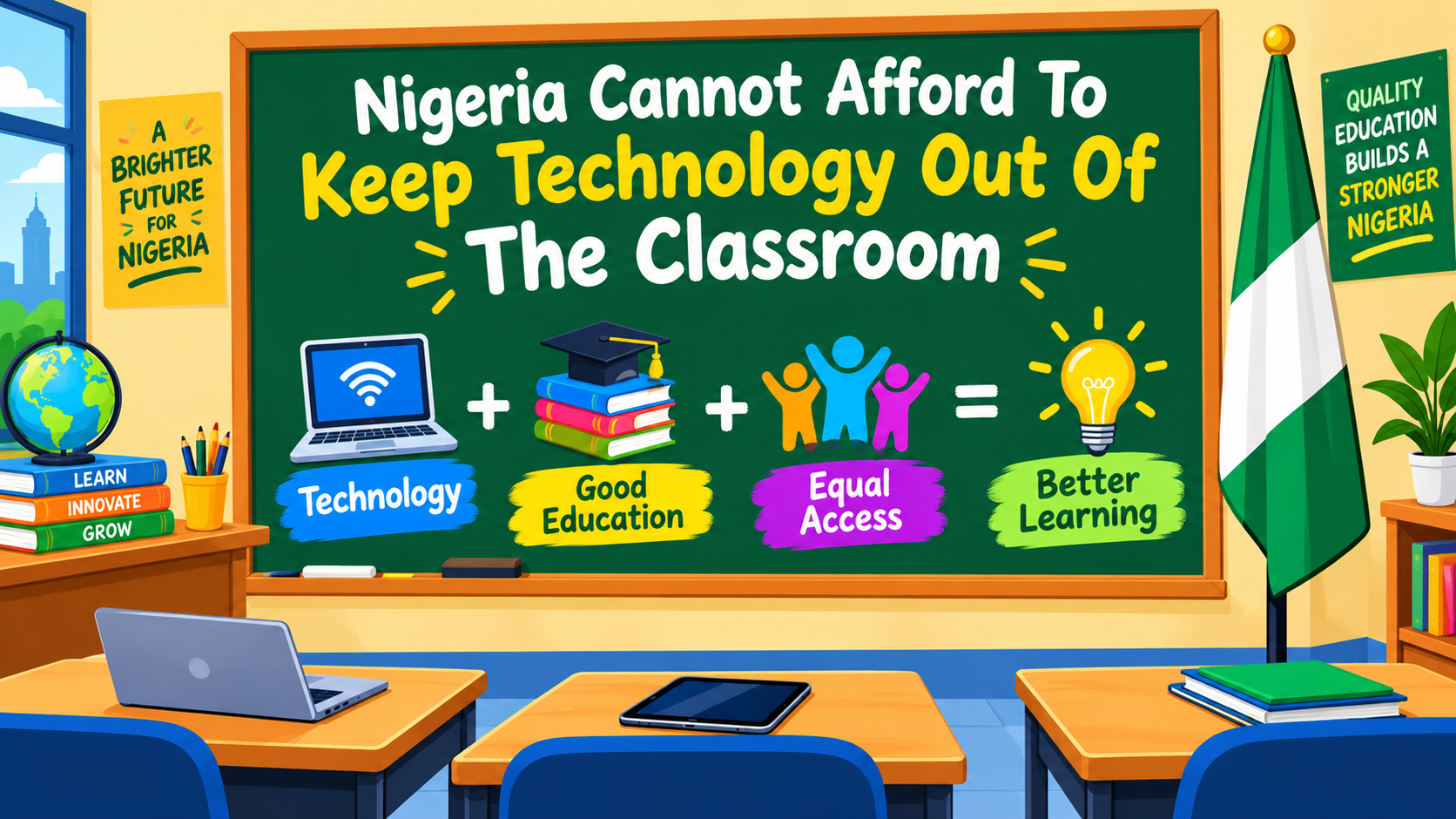
Nigeria Cannot Afford to Keep Technology Out of the Classrooms or Away From Children (Part 2)
3. Even Wealthy Countries Are Struggling to Finance Education
There is another reality that cannot be ignored: quality education is expensive.
Sometimes education discussions make it sound as though Nigeria simply needs to spend enough money and all of its problems will disappear.
Of course, Nigeria needs to invest much more in education.
But the financing challenge is global.
UNESCO estimates that low- and lower-middle-income countries face an annual education financing gap of approximately US$97 billion to achieve their education targets by 2030. UNESCO also reports an extraordinary difference in spending per learner: low-income countries spend roughly US$55 per learner annually, compared with about US$8,532 in high-income countries.
That is a difference of more than 150 times.
The resources available to an education ministry matter enormously.
A wealthy country can make a large investment in school libraries, specialist teachers, counsellors, laboratories, digital infrastructure, sports facilities and teacher development while maintaining extensive social protection systems.
Nigeria has to make difficult choices across education, healthcare, infrastructure, security, electricity, transport, poverty reduction and many other areas simultaneously.
And even wealthy countries do not have unlimited education budgets.
UNESCO’s global education financing data shows that one in three countries is not meeting established education-financing benchmarks, while the global system still faces a massive annual funding gap.
The lesson should not be that Nigeria should spend less.
It is the opposite.
Every naira spent on education needs to produce as much educational value as possible.
This is where technology deserves serious consideration.
Technology can sometimes reduce the marginal cost of distributing high-quality educational content.
A physical textbook has to be printed, transported and replaced.
A digital resource can be updated and distributed across thousands of devices.
A teacher-training programme can be supplemented with online professional development.
A specialist lesson can be recorded once and used repeatedly.
An assessment platform can automatically analyse thousands of responses.
An AI-assisted system can potentially provide immediate feedback on selected learning activities.
None of these eliminates costs. Devices cost money. Connectivity costs money. Software costs money. Electricity costs money. Teacher training costs money. Digital infrastructure requires investment.
But the relevant comparison is not “technology versus free education.”
The relevant question is:
Which combination of physical and digital investments can deliver the greatest improvement in learning for each naira invested?
That is a much more useful policy question.
Technology also creates an opportunity to bring private-sector innovation into education without transferring the government’s entire responsibility to private companies.
Government can provide infrastructure, standards, regulation and funding.
Schools can provide teachers and learning environments.
Technology companies can provide tools, content and innovation.
Foundations and development partners can support pilots and underserved communities.
And parents can participate where they have the means.
The goal should be a blended ecosystem in which every actor contributes.
For Nigeria, the financial reality makes this even more important.
We cannot wait until we have the same resources as high-income countries before preparing Nigerian children for a world already being shaped by those countries’ technologies.
We have to build intelligently with the resources we actually have.
And technology—used carefully and strategically—can be part of that strategy.
4. Nigeria’s Population Is Growing—and That Means More Children to Educate
Nigeria’s education challenge is not static.
The number of children who need education is going to increase.
The United Nations Population Fund estimates Nigeria’s population at approximately 237.5 million in 2025, with 41% of the population aged 0–14. Even if we reduce the number to 200 million and 40%, there will be 80 million children.
That means roughly two out of every five Nigerians are children aged 0–14.
Nigeria’s demographic structure is therefore not simply a population issue.
It is also an education issue.
A growing population can become an enormous economic advantage if children receive the knowledge, health, skills and opportunities required to become productive adults.
But demographic growth can also magnify existing weaknesses.
If Nigeria currently struggles to provide enough classrooms for today’s children, what happens when millions more children enter the education system?
If there is already a shortage of almost 200,000 qualified teachers, what happens when the school-age population continues to expand?
If early childhood education reaches only a minority of three- and four-year-olds, how do we expand coverage fast enough for a much larger generation?
The traditional response would be straightforward:
Build more schools.
Train more teachers.
Build more classrooms.
Buy more textbooks.
Build more laboratories.
Construct more libraries.
All of these things are necessary.
But they are also slow.
A country with a rapidly expanding population cannot rely exclusively on infrastructure that takes years to plan, finance, construct and maintain.
This is one of the strongest arguments for digital education.
Digital systems can scale much faster than physical buildings.
A high-quality educational platform can be deployed across many locations without constructing a new building for every additional learner.
A digital lesson can reach children in Lagos, Kano, Port Harcourt, Enugu or a rural community without requiring the content creator to physically travel to every classroom.
A teacher in a well-resourced school can create or share a resource that can later be used by teachers in schools with fewer resources.
AI can potentially add another layer of scalability by helping personalise learning, generate differentiated practice, analyse performance and provide additional support.
Again, technology does not eliminate the need for schools.
Children need human interaction.
They need teachers.
They need friends.
They need play.
They need physical activity.
They need safe environments.
They need emotional support.
They need practical experiences.
But the choice is not between “traditional school” and “technology.”
The future is much more likely to be a combination of the two.
Nigeria’s population growth makes this combination particularly urgent.
A country with fewer children might be able to expand education primarily through physical infrastructure.
A country with more than 100 million children and adolescents, and a population that continues to grow, needs to think about scale.
And scale is precisely where digital technology has an advantage.
The question Nigeria should be asking is not whether every child should spend more time looking at a screen.
It should be:
How can we use technology to make every teacher more effective, every school better resourced and every child more likely to access quality learning?
Because the next generation of Nigerian children is already on its way.
We cannot build the education system of tomorrow using only the tools of yesterday.
5. The Digital World Is Not Going Away
There is an uncomfortable truth at the centre of the technology debate:
The digital world is not going backwards.
Artificial intelligence, cloud computing, digital payments, online collaboration, automation, robotics, digital commerce and algorithmic systems are becoming increasingly embedded in everyday life.
Children growing up today will not enter a world in which digital technology is optional.
They will enter a world in which digital capability increasingly determines who can learn, work, create, communicate, access information and participate economically.
This creates a difficult choice for education systems.
They can attempt to protect children from technology by keeping technology outside the classroom.
Or they can teach children how to use technology intelligently, safely and responsibly.
The second approach does not mean unlimited screen time.
It means digital literacy.
A child should understand that an AI system can produce an answer that sounds convincing and still be wrong.
A child should understand how algorithms influence what they see online.
A child should know how to protect personal information.
A child should know how to distinguish information from misinformation.
A child should understand that technology is a tool, not a substitute for judgement.
A child should know how to collaborate with digital tools while retaining the ability to think independently.
These are educational skills.
And increasingly, they are life skills.
Africa has already experienced what happens when technological transformation moves faster than our education systems.
The continent did not completely “miss” the internet revolution—Africa has made extraordinary progress in mobile connectivity, mobile money and digital services—but large parts of the continent entered the digital economy with significant gaps in infrastructure, affordability and digital skills.
The World Bank reports that hundreds of millions of Africans gained broadband access between 2019 and 2022, but significant usage and affordability gaps remain. In Sub-Saharan Africa, infrastructure coverage has consistently been ahead of actual usage, illustrating that access alone is not enough.
Nigeria should not repeat that pattern with AI.
We should not wait until artificial intelligence has transformed the global labour market and then begin asking what Nigerian children need to know about it.
By that point, the gap may be far more difficult to close.
This is why technology education should begin before children enter the workforce.
Children do not need advanced programming at age four.
But they can begin learning how computers work.
They can learn sequencing.
They can learn patterns.
They can learn problem-solving.
They can learn about smart machines.
Older children can learn about algorithms, data, AI, bias, responsible technology use and prompt design.
Teenagers can learn to use AI as a research, creativity and productivity tool while being taught to verify its outputs.
This is not about turning children into technology addicts.
It is about ensuring that they are technology literate.
There is a profound difference.
The safest approach is not to pretend the digital world does not exist.
The safest approach is to prepare children to navigate it.
For Nigeria, opting out is not a neutral decision.
If we choose not to prepare children for the digital economy, other countries will continue preparing theirs.
And the resulting gap will not be measured simply in screen time.
It will be measured in productivity, innovation, employment, entrepreneurship and economic opportunity.